Do Shopify Wishlists Actually Increase Sales?
A look at what the data says about Shopify wishlists: return visit rates, average order value lift, social sharing effects, and when wishlists don't move the needle.
By Vellir Technologies · Published 25 March 2026
Bottom line
Yes, in the categories where wishlists fit. Fashion, homewares, and stores where gifts drive demand see meaningful lifts in return visit rate and AOV. Impulse stores with five minute decision cycles see little to no benefit.
The Question We Get Asked
A merchant emails: should we bother adding a wishlist? It feels like extra UI for something most stores ignore. The honest answer is that wishlists do move metrics, but only in some categories, and only when paired with the email and follow up work that turns saved items into return purchases.
Below is what the published data shows, why the mechanism works, and the categories where adding a wishlist is wasted effort.
What the Published Data Shows
There is no single number across the industry to point at. The pattern across published research is steady though:
- Baymard Institute UX research finds that most ecommerce visitors are browsing rather than buying on the first visit, and the lack of a way to save items for later is a documented friction point in their cart abandonment work.
- Statista and similar trackers show high cart abandonment rates (consistently in the 65 to 75 percent range across years and verticals). Many of those abandoners return if the store remembers what they were looking at.
- Shopify case studies from apps in the wishlist space report meaningful uplift in returning visitor rates after install, particularly in fashion and homewares.
The numbers vary by category, traffic mix, and how aggressively the store reaches back out. The shape of the effect, however, stays consistent: stores that capture interest get a second chance to convert it.
Why Wishlists Drive Return Visits
Most first time visitors will not buy. They are deciding whether they like the brand, whether the price is fair, whether the item is what they want, and whether anyone in their life would notice if they showed up wearing it. None of those decisions get made in a single session.
A wishlist gives a visitor somewhere to put the item while they think. Three things follow:
- A bookmark with intent. The customer has told you, by saving it, that this specific item is interesting. That signal is more useful than a page view.
- A trigger for return. If the customer comes back, the wishlist is the first place they look. If they do not, an email reminder (“an item on your wishlist is back in stock”, “your wishlist item is on sale”) is a clean reason to reach out without sending generic promotion.
- A retention surface. Customers who maintain wishlists tend to return more often, in the same way that customers who follow a brand on Instagram tend to return more often. The wishlist is one more thread tying them to the store.
The size of the lift depends on how well the store uses the wishlist data. Saving items is the start; the email program and the work the store does on its own pages is what turns saved items into orders.
The Social Angle: Wishlists as Registries
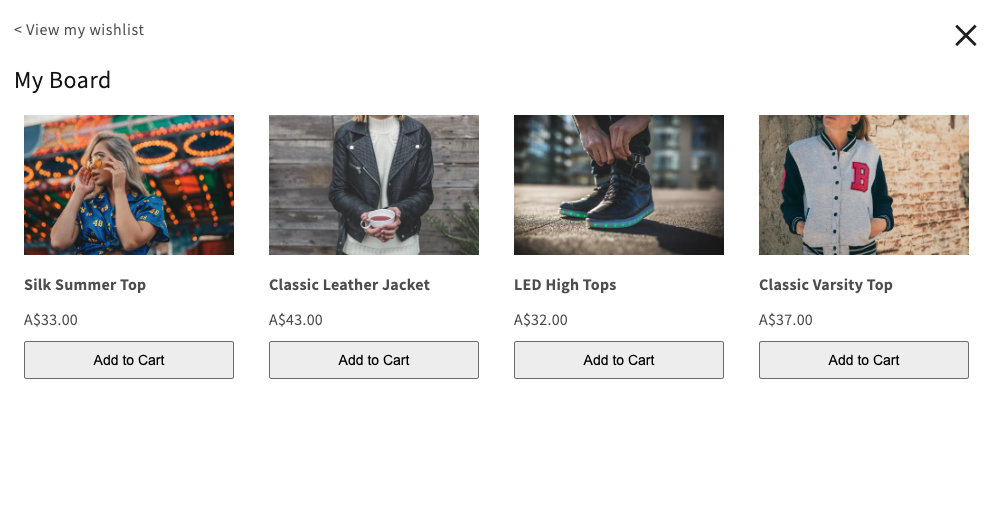
A second, less obvious benefit: shareable wishlists double as gift registries.
Customers who can send their wishlist URL to a partner or family member effectively recruit a second buyer at no acquisition cost. This depends on the category. It works for jewellery, fashion, homewares, baby and children's products, and seasonal categories where gifts are common. It does not work for consumables or items used once.
The volume of shared wishlists is smaller than the volume of personal save for later activity, but shared wishlists tend to convert at higher rates, because the buyer arriving from a shared link already knows what the recipient wants.
When Wishlists Do Not Help
Categories where wishlists rarely move the needle:
- Impulse stores. Single product or low consideration stores where the typical decision cycle is under five minutes. The customer either buys now or never thinks of the store again. A wishlist adds friction without reward.
- Subscriptions and consumables. A wishlist is for items the customer might buy once. A coffee subscription does not need one.
- B2B and consultative sales. When the purchase decision lives in a sales conversation, a wishlist is decoration.
- Stores with no return visit motion. If you have no email program and no plan to reach back out to customers with saved items, the wishlist data goes nowhere. The wishlist itself is cheap; the value comes from what you do with the data.
If your store falls into one of these buckets, the energy is better spent elsewhere.
The Honest Answer
Wishlists are worth adding if three things are true:
- Your customers consider items for more than a few minutes before buying.
- You have or will build an email program that reaches back out around saved items.
- Your category includes some gift or social dimension (or you can reasonably create one).
If all three are true, a wishlist will pay for itself within a quarter or two. If only one or two are true, the math is harder, and the energy probably belongs in checkout optimisation or product photography first.
If You Decide to Add One
Adding a wishlist is one afternoon of work, regardless of whether you build it from theme code, use a feature your premium theme already includes, or install an app. The differences across those four paths are walked through in our practical guide on adding a wishlist to a Shopify store, which goes into each option with the install effort and ongoing cost.
Installation is straightforward. The harder question is whether your store fits the conditions where wishlists earn their place.
Frequently asked questions
- How much do wishlists lift sales?
- Lift varies by category, but in industry benchmarks customers who use wishlists return more often and spend more per order than customers who do not. Wishlists are a way to bring people back to the store, more than a way to lift conversion inside a single session.
- Do wishlists work for impulse stores?
- Generally not. If most customers decide in under five minutes, a wishlist adds friction without reward.
- Should I require an account for wishlists?
- Wishlists that require a login give you sync across devices and a follow up channel. Guest wishlists (using localStorage) reduce friction but lose the customer if they switch device.
- Do wishlists help with gifting?
- Shareable wishlists double as gift registries, a strong angle around birthdays, weddings, and holidays.