Shopify Customer Segmentation: Native Filters vs Apps
When Shopify's native customer segments are enough, when to reach for Klaviyo or analytics tools, and where a dedicated segmentation app fits.
By Vellir Technologies · Published 2 May 2026
Bottom line
Native Shopify segments handle filter based targeting. Klaviyo extends segmentation inside the email channel. Analytics tools (Lifetimely, Polar) help you understand customer value. A dedicated app like SegmentOS fills the behavioural segmentation gap and surfaces VIPs and churn risks across channels.
What You Are Actually Comparing
Customer segmentation is one of those words that means a different thing depending on what you are trying to do with it.
If the goal is to filter customers for a specific email blast, you have one set of options. If the goal is to identify who is about to churn so the team can intervene, you have another set. If the goal is to understand why your LTV looks the way it does, you are in a third place altogether.
The four tool types below each solve one of those goals well and the others poorly. Most stores end up using two or three of them together.
Native Shopify Customer Segments
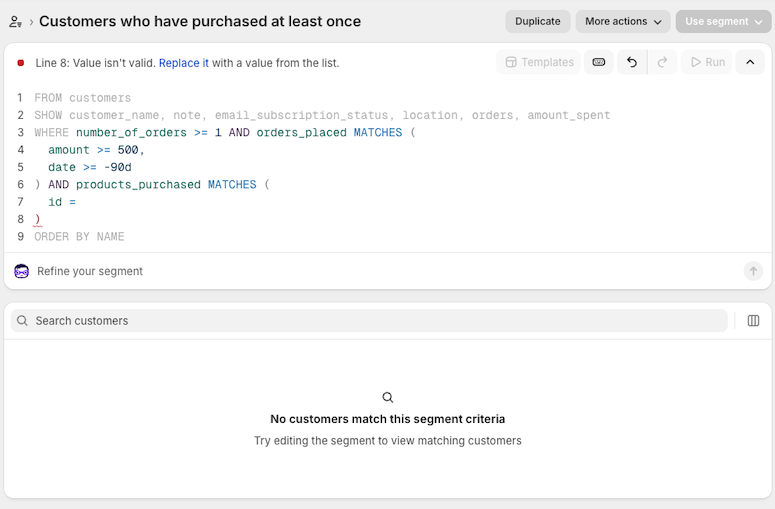
How it works: in Shopify Admin under Customers, build a segment using filter conditions on customer fields (location, last order date, products purchased, email subscriber status).
Strengths:
- Free and built into Admin.
- Updates automatically as customers and orders change.
- Available everywhere a customer list is needed inside Shopify (discounts, exports, email).
Limits:
- Filter based, not score based. You can build “customers from Australia who bought in the last 90 days”. You cannot build “customers most likely to churn”.
- No way to combine across stores without manual export.
- Limited handling of multi axis behaviour (someone who is recent and frequent and high spend at the same time).
Where it fits: filter based campaigns. If your marketing question can be answered with a filter, native segments are usually the right tool.
Klaviyo Segments
How it works: Klaviyo extends segmentation inside the email and SMS channel. It pulls Shopify data via the official integration and builds segments using both filter conditions and behavioural events (opened email X, clicked link Y, abandoned cart, viewed product Z).
Strengths:
- Behavioural triggers Shopify natively cannot reach (email engagement, on site behaviour with the Klaviyo SDK installed).
- Powerful flow builder that fires on segment entry or exit.
- Strong analytics inside the email channel.
Limits:
- Lives inside Klaviyo. Segments do not surface in Shopify Admin or in tools outside the email tool.
- Pricing scales with active profile count. Once your list grows, the bill grows with it.
- Strongest for email and SMS use cases. Less help if you want to act on segments through other channels.
Where it fits: stores running serious email and SMS programs that want behaviour driven targeting inside those channels.
Analytics Tools (Lifetimely, Polar, Triple Whale)
How it works: an analytics tool sits alongside Shopify, ingests order and customer data, and produces dashboards: cohort retention, LTV by acquisition channel, contribution margin by SKU.
Strengths:
- Better at understanding customers than at acting on them. Cohort and LTV analysis is where these tools lead.
- Often surface insights other tools miss (which Facebook campaigns acquire customers who churn fastest, which products drive repeat orders).
Limits:
- Built for understanding more than for segmentation. The output is a dashboard, more than a list of customer IDs you can target.
- Some have segment exports, but the segments are reporting artefacts more than living lists.
Where it fits: stores past the simplest stage that want to understand customer value, more than stores looking primarily for segments to mail to.
Dedicated Segmentation Tools (SegmentOS)
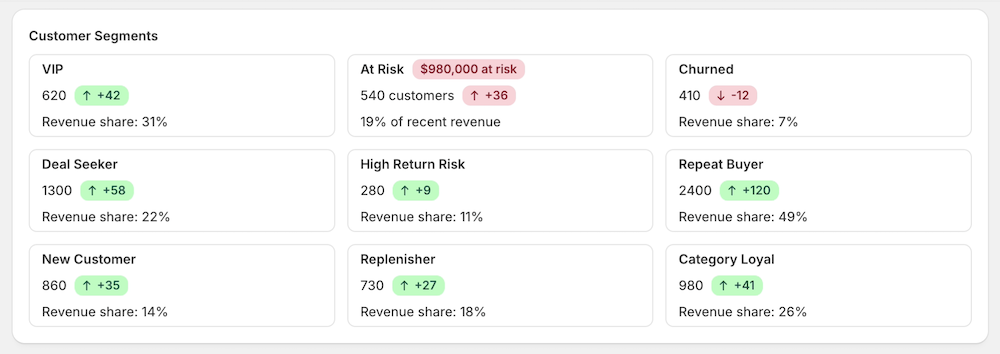
How it works: a tool that connects to Shopify and does the behavioural scoring (RFM and similar) automatically. Customers are placed into segments (champions, at risk, new, hibernating) and the segments stay current as orders come in.
Strengths:
- Surfaces behavioural segments (VIPs, churn risk) that filters cannot reach.
- Updates continuously; no manual refresh.
- Surfaces segments inside Shopify Admin so they are usable wherever you would use a customer list, including downstream tools.
- Often pairs with email tools instead of competing with them.
Limits:
- Adds another tool to the stack. Worth it only if you intend to act on the segments.
- The quality of the segments depends on the volume of customer history available. New stores see less benefit than established ones.
Where it fits: stores with enough customer history to make behavioural segments meaningful, and a marketing function ready to act on VIP and at risk segments specifically.
Methods Compared
| Tool | Cost | Best for | Available in |
|---|---|---|---|
| Native Shopify segments | Free | Filter campaigns | Shopify Admin |
| Klaviyo | Tiered by profile count | Email and SMS triggers | Klaviyo only |
| Analytics tools | Monthly fee | Understanding LTV and cohorts | Separate dashboard |
| SegmentOS | Free tier or paid | VIP and at risk segments | Shopify Admin |
Common Combinations
The combination is where most of the value lives. A few patterns play out repeatedly:
- Small store, email focus. Native Shopify segments plus Klaviyo. Native handles filter based campaigns. Klaviyo handles behavioural email flows. No third tool needed yet.
- Mid sized store, retention focused. Native plus Klaviyo plus a dedicated segmentation tool. SegmentOS or similar identifies VIP and at risk segments, which Klaviyo then mails to.
- Mid sized store, growth focused. Native plus an analytics tool plus Klaviyo. The analytics tool informs strategy (which channels to scale, which products to push); Klaviyo executes.
- Large store, full stack. All four. Each solves a problem the others do not.
Most stores end up at one of these four configurations. Trying to do everything inside one tool is the most common mistake.
What to Pick
Start with native Shopify segments. They are free, sufficient for most filter based campaigns, and the cheapest place to learn what your customer base looks like.
Add Klaviyo (or a similar email tool) when your email program is serious enough to need behavioural triggers and flows.
Add an analytics tool when you have specific questions native dashboards cannot answer (cohort retention, LTV by source, contribution margin).
Add a dedicated segmentation tool when you want to act on VIP and at risk segments without exporting CSVs every week. SegmentOS is one option; the value lives in the segments staying current and being available wherever you need them.
The order matters. Adding tools out of sequence (a segmentation tool before an email channel exists, an analytics tool before there is enough data to analyse) wastes money. Native first, email second, analytics third, dedicated segmentation when retention becomes a focus area.
Frequently asked questions
- Are Shopify's built in customer segments enough?
- For filter based campaigns (location, product purchased, email subscribers), yes. For behavioural targeting like "customers most likely to churn", no.
- Does Klaviyo replace native segments?
- Klaviyo extends them inside the email channel. Native segments still drive filtering inside the store and discount targeting.
- How does SegmentOS differ from Klaviyo segments?
- Klaviyo segments live inside the email tool and are scoped to email campaigns. SegmentOS surfaces VIP and churn risk segments at the store level so they're available to any channel.
- Do I need analytics tools and a segmentation app?
- They serve different jobs. Analytics tools tell you what happened; a segmentation app tells you which customers to act on now.